
Online Event: Facial Image Quality Assessment For Facial Examination
Published on June 22, 2026
THE EVENT
Assessing the quality of facial images is a critical step in forensic facial comparison and other forensic applications. Poor image quality can limit the visibility of facial features, affect comparison outcomes, and reduce confidence in conclusions. Yet image quality assessments are often subjective and can vary between practitioners.
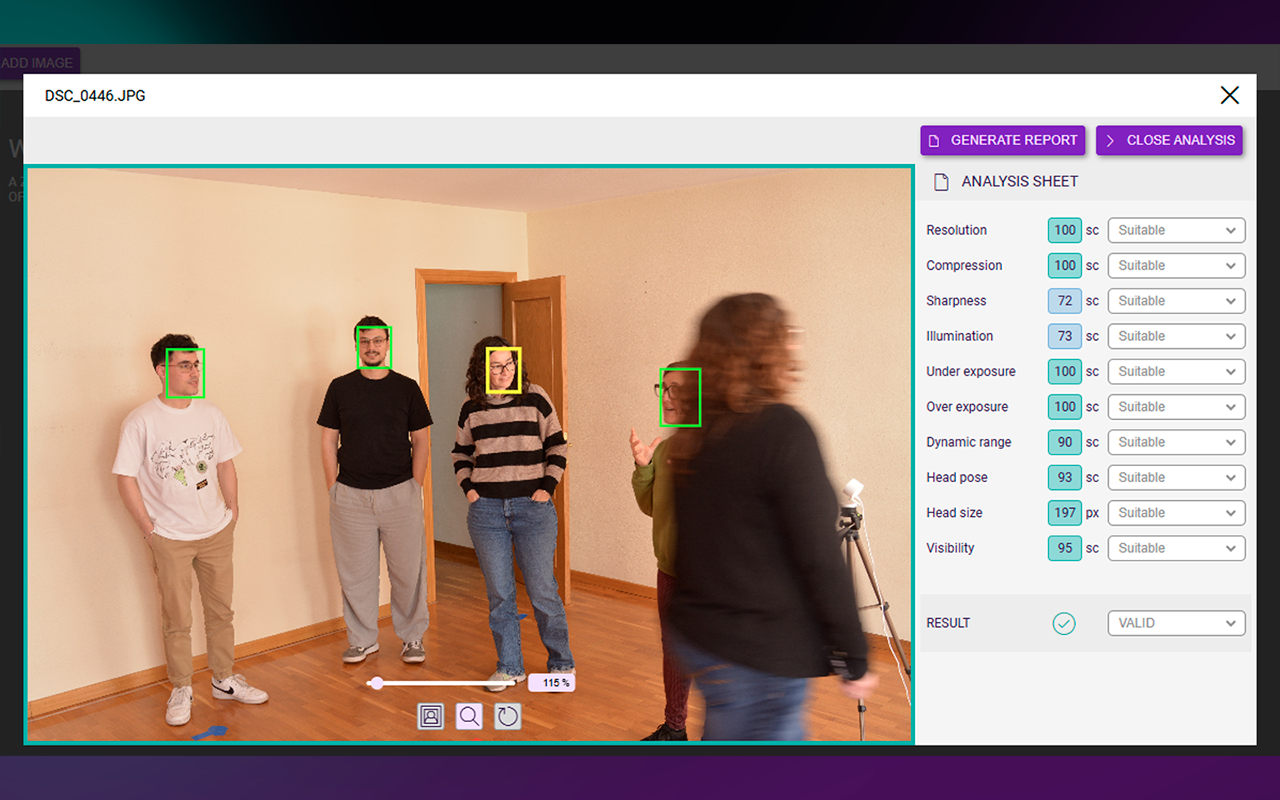
To address this challenge, we developed a Facial Image Quality Assessment (FIQA) application that uses Artificial Intelligence to provide objective and consistent quality measurements.
The tool is based on the OFIQ project developed by the German Federal Office for Information Security (BSI) and maintained by EU-LISA, extending its capabilities to support forensic use cases.
While OFIQ was originally designed for semi-controlled facial images, we have adapted the technology to address a common forensic challenge: the assessment of unconstrained surveillance images. The application evaluates a range of facial image characteristics and presents quality metrics that can help practitioners determine whether an image is suitable for morphological comparison.
In this webinar, we will introduce the principles of Face Image Quality Assessment and demonstrate with the latest Zibian Labs tool how objective image quality metrics can support greater consistency, transparency, and reliability in forensic facial comparison workflows.
This event took place on Thursday, June 25, 2026.
WATCH IT NOW
THE SPEAKERS

Enrique Bermejo, Ph.D.
received his Ph.D. in Computer Science in 2018 from the University of Granada, Spain. He’s been a postdoctoral researcher at the second biology section of The National Research Institute of Police Science (NRIPS, Japan) and the Andalusian Research Institute in Data Science and Computational Intelligence (DaSCI). He is currently a senior AI researcher and product head at Panacea Cooperative Research and an academic collaborator at DaSCI. His main research interests are computer vision and machine learning applications to medical imaging and human identification.

Mª Alejandra Guativonza
Physical and forensic anthropologist working as a research support technician at the University of A Coruña and a collaborator with Panacea Cooperative Research. She holds a bachelor’s degree in Anthropology from the University of the Andes (Colombia), a master’s degree in Physical and Forensic Anthropology from the University of Granada (Spain), and is a doctoral student in Biomedicine. She has worked on projects with Chemonics International’s Colombia branch and the Unit for the Search for Missing Persons (UBPD), with support from the National Institute of Legal Medicine. Her current research focuses on facial identification methods.