
Proposal and validation of forensic facial comparison methodologies using 3D facial mugshots
3D Facial Mugshots
In recent years, police and law enforcement agencies across several countries—both within Europe (Switzerland), and outside of it (Japan)—have implemented, or are currently implementing (Spain), 3D facial capture systems.
Currently, a widely accepted methodological framework exists for Forensic Facial Comparison (FFC) of photograph pairs, developed by the Facial Identification Scientific Working Group (FISWG1 ) in the United States and the European Network of Forensic Science Institutes (ENFSI2). However, there is a lack of studies and methodological proposals addressing comparisons between 3D reference images obtained from 3D mugshots and 2D questioned images.
Methodological Proposals for 3D–2D Forensic Facial Comparison
This study conducted by Panacea Cooperative Research aims to assess the potential and reliability of using 3D facial mugshots within the field of FFC. To this end, four methodological approaches exploring different ways to utilize known 3D facial models are proposed and evaluated.
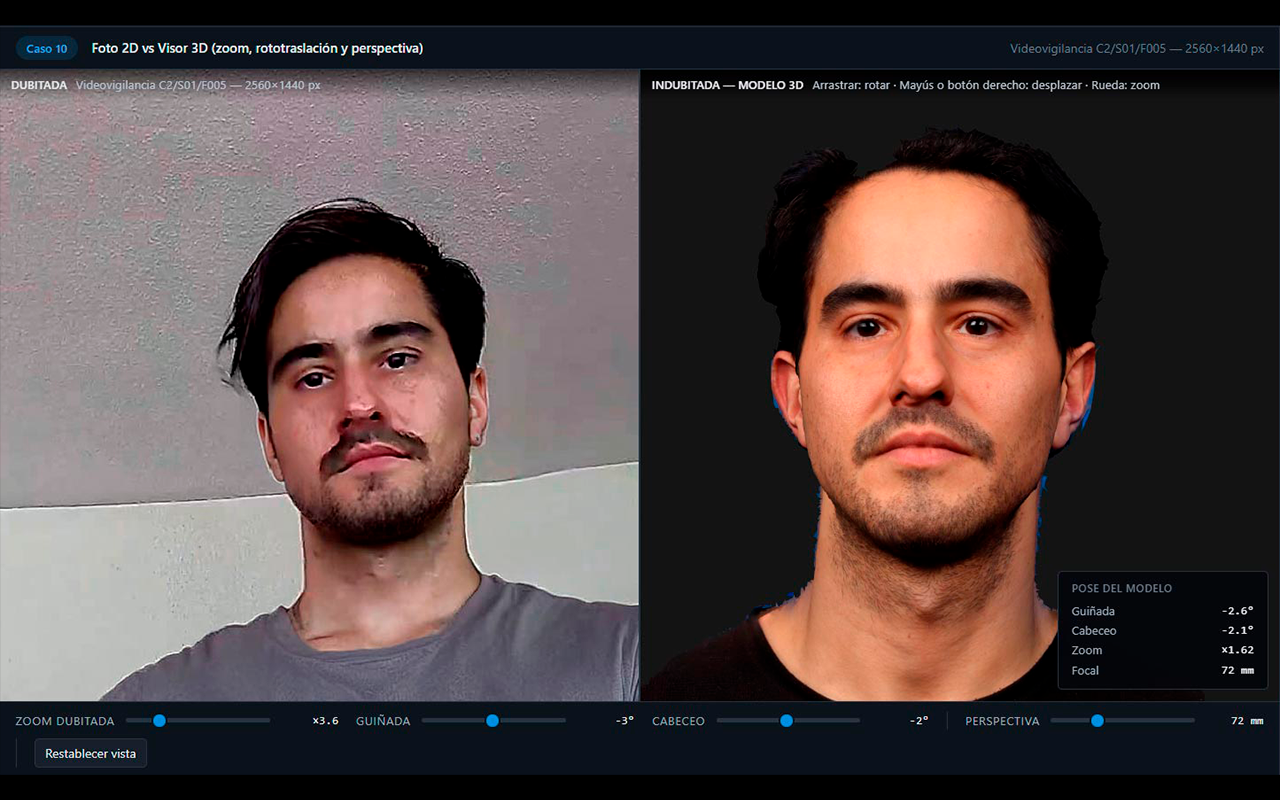
The first three approaches follow the standard morphological analysis framework commonly applied in 2D vs. 2D photo comparisons. For the purpose of the study, the questioned (2D) image is always displayed on one side of the screen, while the other side offers different options for viewing and interacting with the known (3D) facial model:
- The first proposal uses an interactive 3D viewer with basic camera operations like zoom and panning.
- The second proposal includes a more advanced interactive 3D viewer with tools to correct and adjust for perspective distortion.
- The third one generates a 2D projection from the 3D model that replicates the exact camera parameters of the questioned image (pose and perspective distortion).
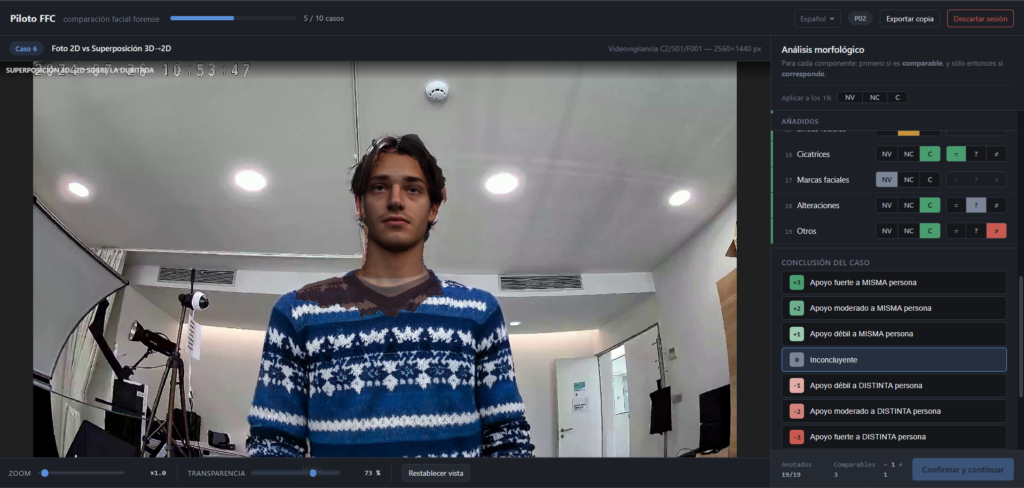
A fourth methodological approach is also proposed, based on the direct superimposition of the reference 3D model over the questioned 2D image. Similar to the third approach, the camera parameters of the questioned image (pose and perspective distortion) are replicated. The examiner has access to transparency/opacity sliders and wipe tools to evaluate the alignment and correspondence of morphological features.
Pilot Study
To assess the performance of each alternative, their efficacy will be benchmarked against one another and compared to the conventional 2D–2D comparison method (for which a standardized photograph will be provided for the known sample).
Currently, an international panel of experts is participating in a pilot study evaluating questioned and known image pairs across each of the four proposed scenarios. Throughout this process, examiners complete the standardized morphological feature list established by FISWG and ENFSI. The image pairs are sourced from the IdentAI dataset; the questioned images have undergone editing to increase case complexity and difficulty.
FUTURE
We aim to expand this study in terms of both sample size and the composition of the evaluation panel. The goal is to involve examiners from various institutions with diverse levels of training and practical experience in forensic facial comparison.
HOW TO JOIN US
Would you like to participate in the study?
You can join the evaluation panel by completing the form below, after which all relevant participation details will be sent to you.
1 FISWG, «Facial Comparison Overview and Methodology Guidelines».
2 ENFSI, «Best Practice Manual for Facial Image Comparison».